Retritis
Retritis (n.): inflammation caused by repeated retries. A chronic condition of agent-assisted development. No known cure — only palliative treatments.
The retritis suite is a set of MCP servers and DuckDB extensions for coding agents. It gives an agent typed, indexed tools for code, builds, git and memory, so it does not have to drive everything through a raw shell. It works with Claude Code and with any other MCP client.
Install the suite · Read the field guide · See every tool
Diagnosis
You have retritis if:
You’ve copy-pasted terminal output into a chat window more than twice today
You’ve typed
git add . && git commit -m "wip" && git pushfrom muscle memory while an agent watchesYou’ve explained the same codebase structure to three different Claude sessions
You’ve lost work to a session crash and reconstructed it by hand
You’ve written a bash script to avoid writing a bash script
Treatment
Each tool treats one symptom.
Symptom |
Treatment |
What it does |
|---|---|---|
Pasting build output into the chat |
Runs builds and tests, keeps the output, and lets the agent query the errors later. |
|
|
Save, sync and ship as single steps. Each step shows a plan that you confirm first. |
|
Explaining the codebase again |
Code as queryable data: definitions, callers, structure and history, from an AST index. |
|
Context lost between sessions |
Memory across sessions: briefings, recurring patterns and trust scores. |
|
A bash script to avoid a bash script |
Watches the agent’s tool calls and suggests the structured tool instead of the shell. |
|
Repeating small multi-step chores |
Turns a plain request into a small, checked program and runs it on a local model. |
How it fits together
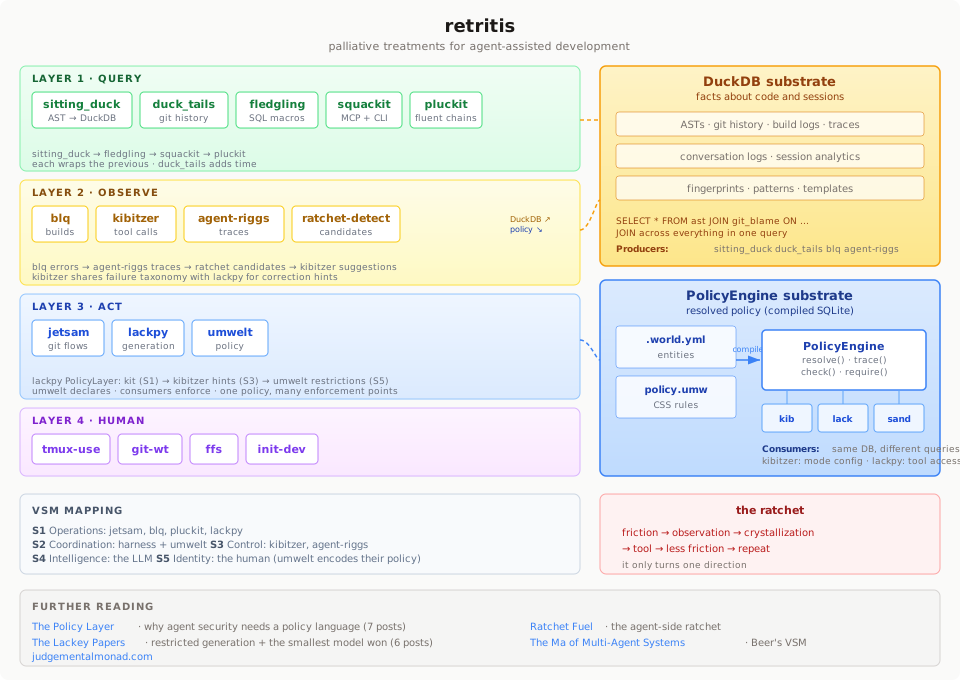
The suite has two shared substrates, and you can query both with SQL. DuckDB stores facts about code, builds and sessions. SQLite stores resolved policy, compiled by umwelt. Tools share data through these files. They do not need a server between them.
The ratchet
Each tool in this suite addresses a specific symptom. None of them came from a plan. They came from the moment where you think “I’ve done this enough times.” Friction produces signal. Signal crystallizes into a tool. The tool reduces friction. New friction appears at a higher level. Repeat.
This is the ratchet. It only turns one direction.
What it saves
Measured 2026-05-25, against grep for the same questions:
Question type |
Tool |
Context cost compared to grep |
|---|---|---|
Find a definition or name (AST query) |
squackit |
96–99% fewer tokens, under one second |
Search by text (BM25 index) |
squackit search |
73–82% fewer tokens, about 10–20 ms after a one-time 2 s index build |
These numbers are from May 2026. The tools have changed since then.